
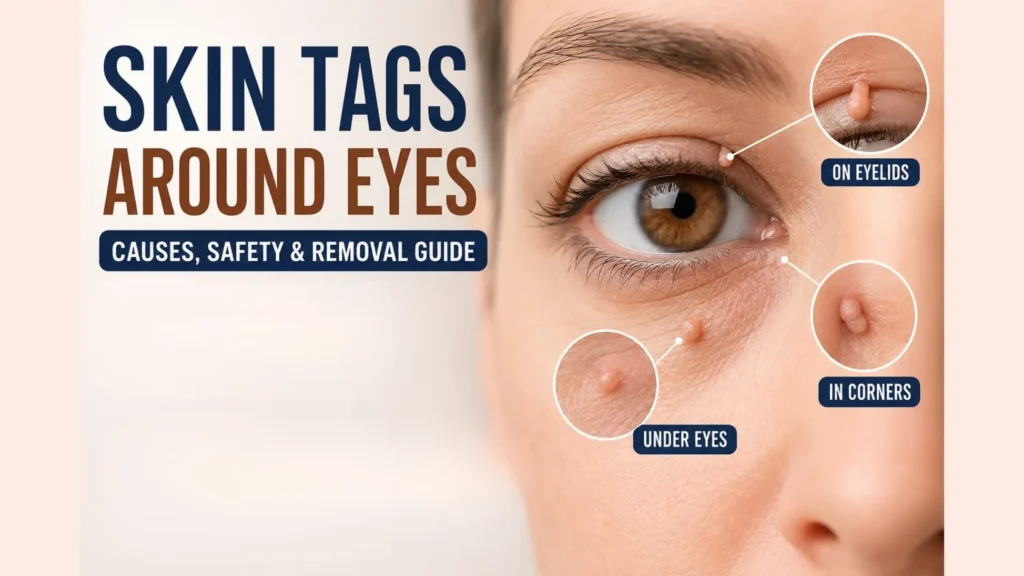
If you’ve recently noticed a small, soft growth near your eyelid or under your eye, you’re not alone. Skin tags around eyes are one of the most common benign skin concerns that dermatologists encounter daily.
While completely harmless in most cases, they can be bothersome, cosmetically or physically, and many people want to understand why they appear and what can be done about them.
In this comprehensive guide, we’ll walk you through everything you need to know about skin tags on eyes and eyelids: what they are, why they form, how they’re diagnosed, and the safest, most effective ways to remove them.
What Are Skin Tags Around the Eyes?
Skin tags (medically known as acrochordons) are small, non-cancerous (benign) growths that develop on the surface of the skin. They can range in size from as tiny as 1 millimeter to a few centimeters. Some dangle off the skin from a thin stalk, while others sit flat and firmly attached to the skin surface.
Skin tags on eyelids and the surrounding eye area are among the most frequently reported locations. They typically appear:
- On the upper or lower eyelid margin
- In the inner or outer corners of the eyes
- As small skin tags under eyes along the orbital rim
- On the delicate skin of the eyelid fold
They are usually skin-colored, though they can occasionally appear slightly darker or pinkish, especially if they become irritated. Because the skin around the eyes is exceptionally thin and sensitive, even a very small skin tag in this area can feel more noticeable than those found elsewhere on the body.
Why Do I Get Skin Tags Around My Eyes?
This is one of the most common questions patients ask their dermatologists: “Why do I get skin tags around my eyes?” The answer involves a combination of genetic, metabolic, and lifestyle factors.
1. Genetics
The number one cause of skin tags is simply your genetic makeup. If your parents or close relatives developed skin tags, you are significantly more likely to develop them too, including around the delicate eye area.
2. Friction and Skin Rubbing
Skin tags tend to develop in areas where skin rubs against skin or against clothing and accessories. The eye area, particularly the eyelids, experiences constant micro-movement, blinking thousands of times a day, which creates the kind of repetitive friction that promotes skin tag formation.
3. Insulin Resistance and Diabetes
There is a well-established link between skin tags eye occurrence and metabolic conditions like insulin resistance, pre-diabetes, and type 2 diabetes. If you notice skin tags under eye or anywhere on your face and body appearing frequently, it may be worth discussing blood sugar levels with your doctor.
4. Hormonal Changes During Pregnancy
Pregnancy triggers significant hormonal shifts along with natural weight gain, and both factors can contribute to the development of skin tags on eye lids and other areas. Interestingly, some pregnancy-related skin tags may fade or disappear postpartum as hormones stabilize, though this is not guaranteed.
5. Age
As skin ages, it loses collagen density and elasticity, making the skin around the eyes more susceptible to developing small tags and growths. Skin tags become increasingly common after the age of 40.
6. Being Overweight
Excess body fat increases skin-to-skin friction across the body, and while the eye area itself doesn’t carry fat deposits, the systemic hormonal environment associated with being overweight, particularly elevated insulin levels, increases the likelihood of skin tag formation everywhere, including around the eyes.
How to Tell If It’s a Skin Tag — Or Something Else
Not every small growth near your eye is a skin tag. Several other conditions can closely mimic the appearance of skin tags around eyes, and this is precisely why self-diagnosis and at-home removal are strongly discouraged.
Conditions that can look similar include:
- Seborrheic keratosis — a rough, waxy benign growth
- Skin-colored moles (nevi) — which require monitoring for changes
- Warts or molluscum contagiosum — viral skin infections
- Milia — small white cysts common under the eyes
- Syringomas — benign sweat duct tumors, common under the eyes
- Skin cancer — in rare but serious cases, a growth that resembles a skin tag could be a melanoma or basal cell carcinoma
A board-certified dermatologist recounted a striking case where what appeared to be a routine skin tag in a patient turned out to be a melanoma upon pathological examination. This underscores the critical importance of professional evaluation before any removal is attempted.
Are Skin Tags Around the Eyes Dangerous?
In the vast majority of cases, skin tags around eyes are entirely benign and pose no medical risk. They do not turn cancerous on their own, and they don’t spread or multiply through contact.
However, you should seek medical evaluation if a skin tag near your eye:
- Changes in size, shape, or color
- Becomes red, irritated, or tender
- Bleeds without trauma
- Grows rapidly over a short period
- Looks unusual or asymmetrical
These changes could indicate that the growth is something other than a simple skin tag and warrants professional assessment.
Safe Removal of Skin Tags on Eyelids: What Your Dermatologist Can Do
If your skin tags on eye lids are bothering you cosmetically or causing irritation, there are several safe, effective in-office removal options. The key word here is in-office, home removal near the eye area is particularly dangerous given the proximity to your vision.
1. Surgical Excision (Most Common for the Eye Area)
This is the preferred method for skin tags around eyes. A tiny amount of local anesthetic (such as lidocaine) is injected to numb the area, and then the tag is carefully removed with surgical scissors or a fine blade. The wound heals quickly, and the removed tissue can be sent to pathology for microscopic analysis — a critical safety step.
Surgical excision is specifically preferred around the eye area because burning and freezing methods carry more risk when performed so close to the eye.
2. Cryosurgery (Freezing)
Cryosurgery uses liquid nitrogen to freeze and destroy the skin tag. It works best for small tags with thin stalks. After freezing, the tag typically falls off within a week. This method is generally avoided very close to the eye due to the risk of damage to surrounding sensitive tissue.
3. Electrodesiccation (Burning/Cauterization)
This technique uses a small electrical current to burn and destroy the tag. It’s very precise, making it useful for tiny skin tags, particularly on the neck and face. However, near the eye itself, surgical removal is usually preferred.
Is Skin Tag Removal Covered by Insurance?
If your skin tags eye growths are causing medical symptoms — bleeding, irritation, or inflammation — removal may be covered by insurance. If removal is purely cosmetic, it will typically be an out-of-pocket expense.
Why You Should Never Remove Skin Tags Around the Eyes at Home
It cannot be stressed enough: do not attempt to remove skin tags around your eyes at home. The risks are significant and include:
- Serious infection — the eye area is extremely vulnerable to bacterial and viral infections
- Permanent scarring close to a highly visible area
- Eye injury — any slip near your eye could cause lasting damage to your vision
- Misdiagnosis risk — removing what you think is a skin tag could mean leaving a melanoma or skin cancer undetected and untreated
- Excessive bleeding — skin tags near the eye can have a robust blood supply
Products marketed on social media — “skin tag zappers,” freezing kits, tying-off devices, or wart remover — are not safe for use near the eyes. Regardless of how convincing the before-and-after content looks, these products can cause serious, irreversible harm.
Can Skin Tags Around the Eyes Be Prevented?
While you can’t completely prevent skin tags if you’re genetically predisposed, there are steps that may reduce their frequency:
- Manage blood sugar levels — addressing insulin resistance or diabetes can slow the development of new skin tags
- Maintain a healthy weight — reducing excess skin friction lowers risk
- Avoid unnecessary rubbing of the eye area
- Gentle skincare — use non-irritating products around the eyes to minimize friction and inflammation
When to See a Doctor
You should consult a board-certified dermatologist if:
- You notice small skin tags under eyes or on eyelids for the first time
- An existing growth changes in appearance
- A skin tag becomes painful, bleeds, or looks inflamed
- You are unsure whether a growth is a skin tag or something else
- You want cosmetic removal performed safely
Early evaluation is always the safest and smartest choice — especially for growths near the eyes.
Final Thoughts
Skin tags around eyes are a common, benign skin condition that affects millions of people worldwide. Understanding why do I get skin tags around my eyes — whether due to genetics, friction, hormonal changes, or metabolic factors — can help you make informed decisions about prevention and treatment.
The most important takeaway: always have growths near your eyes evaluated and treated by a qualified dermatologist. With in-office procedures that are quick, safe, and largely well-tolerated, there’s simply no reason to risk at-home removal — especially in such a sensitive and irreplaceable area of your face.
Disclaimer: This article is intended for informational purposes only and does not constitute medical advice. Always consult a board-certified dermatologist or qualified healthcare provider for diagnosis and treatment.